Rainbow Romance Font for Warm, Memorable Branding
As a small business owner who designs every label, posts every Instagram story, and handwrites every thank-you card, I know how much a single font can shape how customers feel about my brand—before they even read a word. That’s why I reached for Rainbow Romance the moment I saw it: a display font that doesn’t just catch the eye—it invites trust, joy, and connection.
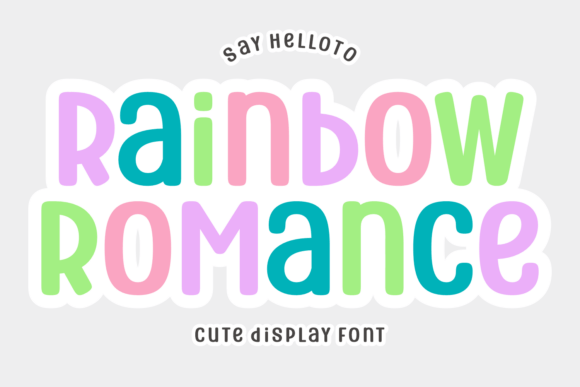
Rainbow Romance is a playful, rounded, multi-hued-inspired typeface—not literally rainbow-colored, but designed with gentle curves, soft edges, and rhythmic spacing that evokes childlike wonder without sacrificing clarity. It’s cheerful but not chaotic; expressive but never overwhelming. Think of it as the visual equivalent of a warm smile or a handwritten note tucked into a package. It belongs to the display font category, meaning it shines brightest where you want attention: logos, banners, packaging headers, and social media graphics.
In my own café-branded candle line, I used Rainbow Romance for the product name on each jar label—paired with a clean sans serif like Inter or Montserrat for ingredients and care instructions. The contrast worked beautifully: Rainbow Romance gave personality and warmth; the sans serif kept things legible and grounded. Customers told me the labels “felt handmade but polished”—exactly the balance I was aiming for.
This font thrives in real-world touchpoints where emotion matters. Use it for:
- Your boutique’s logo or window decal—especially if your aesthetic leans cozy, nostalgic, or whimsical
- Menu headers at your plant-based café or children’s bookstore
- Instagram carousel titles and Pinterest quote graphics (it scales well up to 48pt on mobile)
- Stickers and gift tags for handmade goods—its open letterforms hold up even when printed small on matte paper
- Digital ads and email banners where you need instant recognition in under two seconds
Rainbow Romance isn’t meant for body text—and that’s intentional. As a display font, it’s strongest when used selectively: one headline per page, your shop name on packaging, or the title of a seasonal promotion. Overuse dilutes impact and risks readability, especially on low-resolution screens or fine-print labels. I tested it on a 1.5-inch product sticker at 12pt size and found it softened too much—so I reserved it for 16pt+ applications only. That discipline actually helped me build a more consistent brand voice: Rainbow Romance says “this is special,” while my supporting typeface handles the details.
Consistency builds recognition—and recognition builds trust. When customers see Rainbow Romance on your website banner, then again on your receipt footer and your Instagram Story highlight icon, they begin to associate that friendly, confident energy with your business. That’s how a font becomes part of your brand identity—not just decoration, but quiet reinforcement of who you are.
Pairing Rainbow Romance thoughtfully makes all the difference. My go-to combo? Rainbow Romance + a neutral sans serif (like Poppins or Open Sans) for balance. For a more tactile, artisanal feel, I’ve paired it with a light serif like Lora or Playfair Display—especially for coaching businesses or wellness brands that want warmth with quiet authority. Avoid pairing it with other decorative fonts (no second script or heavy display type), and steer clear of ultra-thin or condensed sans serifs that clash with its generous proportions.
Before committing across your whole brand, test Rainbow Romance in context. Drop it into your Canva template for a real product label. Paste it into your Shopify theme preview. Print a mock-up of your business card at actual size. Notice how it behaves next to photography, icons, and color blocks. Does it pop—or get lost? Does it feel aligned with your ideal customer’s expectations? A bakery targeting young families might find Rainbow Romance instantly resonant; a luxury skincare brand may prefer something more refined. There’s no universal “best”—only what serves your audience and message.
Licensing matters—especially for small businesses. Rainbow Romance is a commercial font, so double-check its license before using it on physical products (like mugs or tote bags), digital templates you sell, or client work. Most reputable font vendors clearly state whether a license covers merchandise, web embedding, or app use. When in doubt, reach out to the designer or vendor directly. Skipping this step could mean redesigning assets later—or worse, receiving a cease-and-desist. Protect your time and investment by confirming permissions upfront.
For service-based creators—life coaches, freelance designers, educators—I’ve used Rainbow Romance in webinar slide headers and downloadable workbook covers. It signals approachability without sacrificing professionalism. One coach told me her clients said her materials “felt like talking to a friend who knows their stuff.” That’s the power of intentional typography: it shapes perception before a single sentence is read.
Rainbow Romance won’t fix inconsistent branding on its own—but paired with thoughtful application, it becomes a reliable tool for expressing warmth, authenticity, and care. It reminds me—and my customers—that business doesn’t have to feel cold or corporate to be credible. In fact, the most memorable brands often feel human first, and professional second.
If your brand lives at the intersection of creativity and kindness—if your customers choose you because you make them feel seen, uplifted, or inspired—then Rainbow Romance isn’t just another display font. It’s a subtle, joyful alignment between who you are and how you show up.